Main Abnormalities
- Broad complex tachycardia at ~ 120 bpm.
- Pacing spikes precede each QRS complex.
- LBBB morphology (dominant S wave in V1-2) indicates a pacing electrode in the right ventricle.
- Negative concordance is seen in V1-6 (all precordial leads
show negative complexes). This is an often-cited feature of VT, but also
occurs with paced rhythms. It simply indicates that ventricular
depolarisation is spreading from anterior to posterior (away from V1-6),
e.g. due to a pacemaker electrode stimulating the anterior wall of the
RV.
These features are consistent with a pacemaker malfunction resulting in a rapid ventricular-paced rhythm.
Differential Diagnosis
The differential diagnosis of this rhythm includes:
Pacemaker Mediated Tachycardia (PMT)
This is a re-entrant rhythm involving the pacemaker circuit. It behaves very much like the atrioventricular re-entry tachycardia (AVRT) seen with WPW syndrome, except that in this case the “accessory pathway” is formed by the pacemaker circuit.
PMT is triggered when ventricular impulses pass retrogradely through the AV node and depolarise the atria.
The retrograde P wave is sensed by the pacemaker, which then immediately paces the ventricles. This is followed by another retrograde P wave that maintains the circus movement.
The rhythm can be terminated by activating magnet mode (which switches off sensing), or by reprogramming the pacemaker box (e.g. increasing the refractory period to “block out” the retrograde P waves).
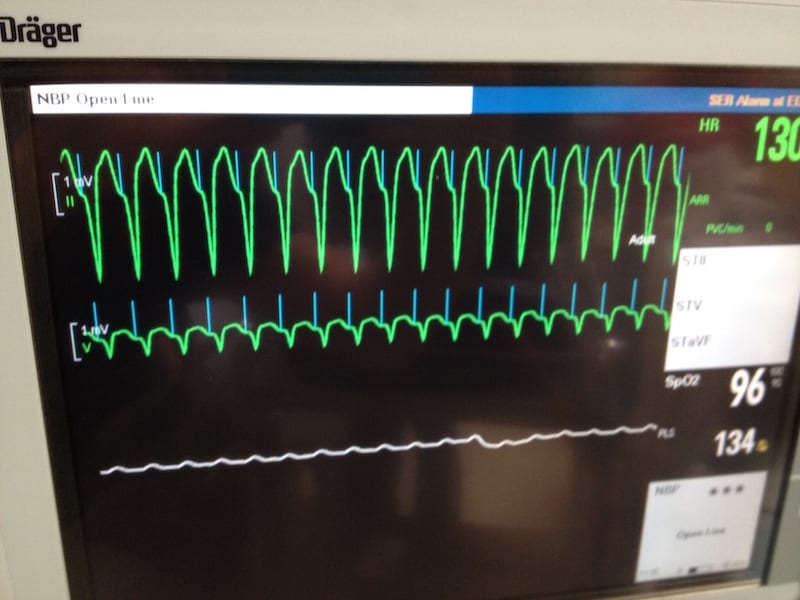
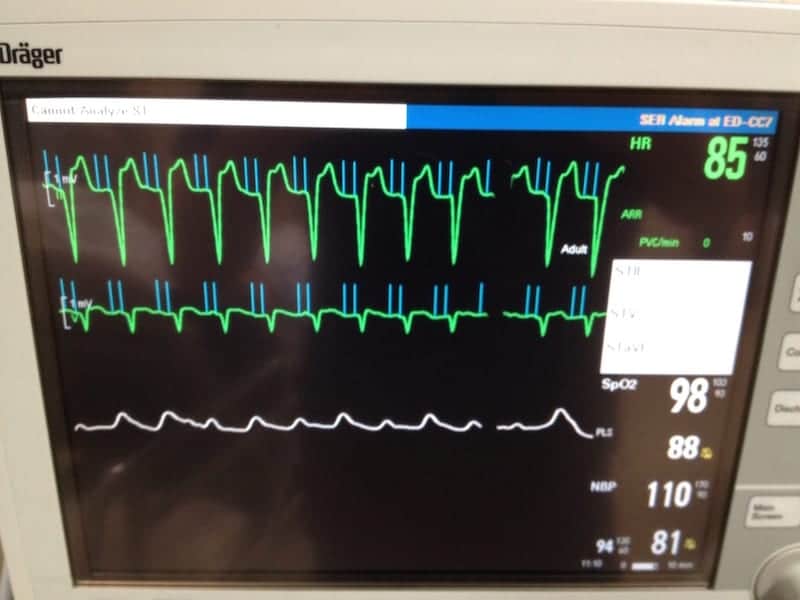
Sensor Induced Tachycardia (SIT)
- Modern pacemakers are programmed to allow increased heart rates in
response to physiological stimuli such as exercise, tachypnoea,
hypercapnia or acidaemia. - Sensors may “misfire” in the presence of distracting stimuli such as
vibrations, loud noises, fever, limb movement, hyperventilation or
electrocautery (e.g. during surgery). - This misfiring leads to pacing at an inappropriately fast rate.
- The ventricular rate cannot exceed the pacemaker’s upper rate limit.
- Similar to PMT, these may also terminate with application of a magnet, or with removal of the inciting stimulus.