Normal serum magnesium levels are generally considered to be 0.8 – 1.0 mmol/L. Hypomagnesaemia, defined as a level < 0.8 mmol/L, is associated with QT interval prolongation and an increased risk of ventricular arrhythmias.
ECG changes in isolated hypomagnesaemia
Patients with hypomagnesaemia often have concurrent hypokalaemia and/or hypocalcaemia and associated ECG features of these conditions.
Most literature on the ECG in hypomagnesaemia has not excluded patients with these other electrolyte disturbances, making exact changes difficult to ascertain. The only identifiable study examining patients with isolated hypomagnesaemia found no significant differences in QRS duration or ST segments compared to baseline ECGs.
Clinical relevance
- Correction of serum magnesium to > 1.0 mmol/L, with concurrent correction of serum potassium to > 4.0 mmol/L, is often effective in suppressing ectopy and supraventricular tachyarrhythmias
- A rapid IV bolus of magnesium 2g is a standard emergency treatment for torsades de pointes
- Further information regarding the causes and other clinical manifestations of hypomagnesaemia can be found here
ECG examples
Example 1
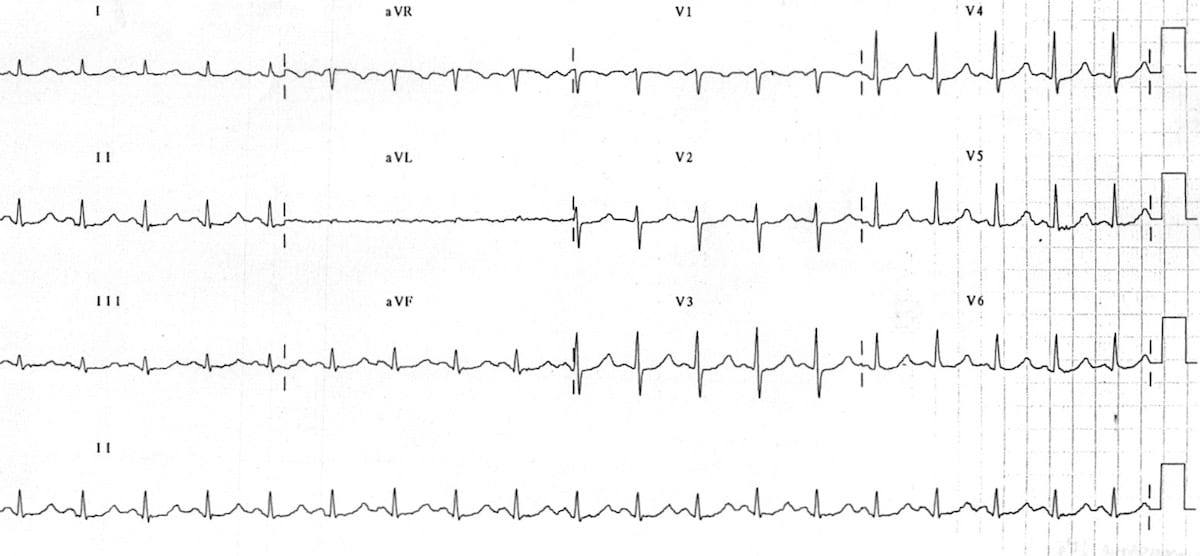
The following ECGs were taken from a 76-year-old man presenting with palpitations. He was found to have a serum Magnesium level of 0.28 mmol/L.
Example 2a
- There are runs of nonsustained ventricular tachycardia (NSVT), as well as ventricular ectopics
- QTC during normal rhythm is 465ms
Example 2b
- Repeat ECG 30 minutes later, when the patient entered conscious sustained VT
References
Advanced Reading
Online
Textbooks
- Zimmerman FH. ECG Core Curriculum. 2023
- Mattu A, Berberian J, Brady WJ. Emergency ECGs: Case-Based Review and Interpretations, 2022
- Straus DG, Schocken DD. Marriott’s Practical Electrocardiography 13e, 2021
- Brady WJ, Lipinski MJ et al. Electrocardiogram in Clinical Medicine. 1e, 2020
- Mattu A, Tabas JA, Brady WJ. Electrocardiography in Emergency, Acute, and Critical Care. 2e, 2019
- Hampton J, Adlam D. The ECG Made Practical 7e, 2019
- Kühn P, Lang C, Wiesbauer F. ECG Mastery: The Simplest Way to Learn the ECG. 2015
- Grauer K. ECG Pocket Brain (Expanded) 6e, 2014
- Surawicz B, Knilans T. Chou’s Electrocardiography in Clinical Practice: Adult and Pediatric 6e, 2008
- Chan TC. ECG in Emergency Medicine and Acute Care 1e, 2004
LITFL Further Reading
MBBS DDU (Emergency) CCPU. Adult/Paediatric Emergency Medicine Advanced Trainee in Melbourne, Australia. Special interests in diagnostic and procedural ultrasound, medical education, and ECG interpretation. Co-creator of the LITFL ECG Library. Twitter: @rob_buttner
Emergency Medicine Specialist MBChB FRCEM FACEM. Medical Education, Cardiology and Web Based Resources | @jjlarkin78 | LinkedIn |