Main Abnormalities
This is a classic ECG of tricyclic antidepressant toxicity, demonstrating multiple characteristic abnormalities.
Signs of sodium-channel blockade
- Broad QRS complexes (120 ms, or 3 small squares).
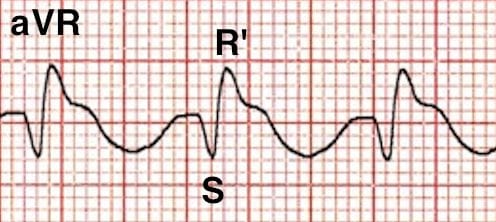
- Positive R’ wave in lead aVR > 3 mm.
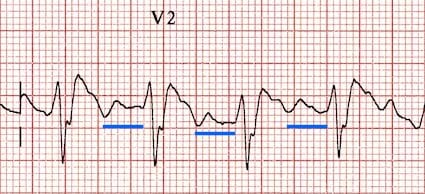
- Prolonged PR interval (240 ms).
- Long QT interval (> 1/2 the RR interval).
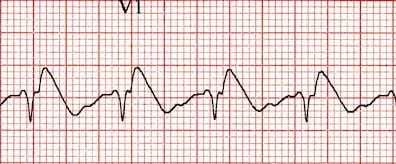
- Brugada-like pattern in V1.
Signs of anticholinergic toxidrome
Sinus tachycardia (~ 110 bpm), with P waves embedded in each T wave
This patient had taken a life-threatening overdose of dosulepin (a Tricyclic antidepressant TCA).
How to Spot Sodium-Channel Blockade
- QRS prolongation (> 100ms or 2.5 small squares), typically measured in lead II.
- A terminal or secondary R wave (R’ wave) in aVR > 3 mm.
- An R’/S ratio in aVR > 0.7.
Prognostic Value of the ECG
In patients with TCA overdose, the degree of QRS prolongation correlates with the degree of clinical toxicity:
- QRS width > 100 ms is predictive of seizures.
- QRS width > 160 ms is predictive of cardiotoxicity (e.g. broad-complex dysrhythmias, hypotension).